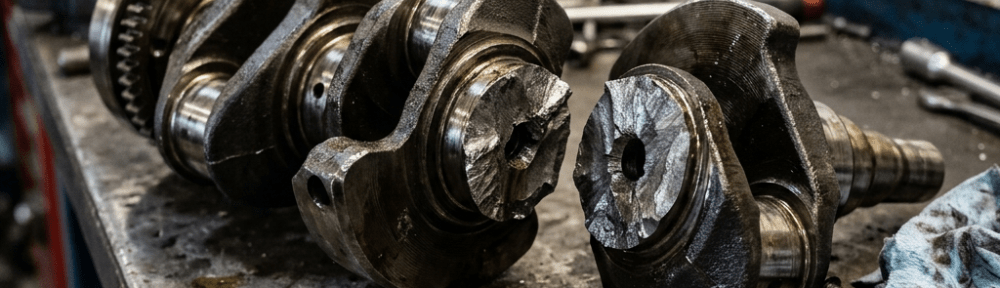
Under the hood, the illusion of a simple repair
This article is available in English. To view the English translation for any section, simply click the prompt « Read the English version below — click to expand » before each illustration or picture. The English text will then be displayed.
LE SILENCE APRES L’ALERTE / After the Beep
Il y a des pannes franches, brutales, évidentes. Celles qui arrêtent tout et ne laissent aucun doute. Et puis il y a les autres. Les plus trompeuses. Celles qui continuent à tourner, à respirer, à donner juste assez d’espoir pour masquer la gravité réelle du mal.
Dans les épisodes précédents, le moteur avait perdu de la puissance en vol. Un événement sérieux, mais sans symptôme immédiatement limpide. L’atterrissage avait eu lieu, la machine était revenue au hangar, entière. Restait à comprendre.
Les semaines avaient passé. Puis les mois. L’indisponibilité, la vie, les contraintes… jusqu’au jour où, enfin, le capot s’ouvre de nouveau.
Personne ne le sait encore, mais la vérité est déjà là. Cachée au cœur du moteur. Fendue. Prête à se révéler.
Read the English version below — click to expand
There are failures that are sudden, brutal, and undeniable—the kind that bring everything to a halt and leave no room for doubt. And then there are the others. The deceptive ones. The kind that keep running, keep breathing, giving just enough hope to mask the true severity of the problem.
In the previous episodes, the engine had lost power mid-flight. A serious event, but one without immediately obvious symptoms. The landing was uneventful; the machine returned to the hangar, intact. The real work—understanding why—was only just beginning.
Weeks passed. Then months. Distractions, life, constraints… until the day finally arrived when the hood was lifted once more.
No one knows it yet, but the truth is already there. Hidden deep within the engine. Cracked. Waiting to be revealed.
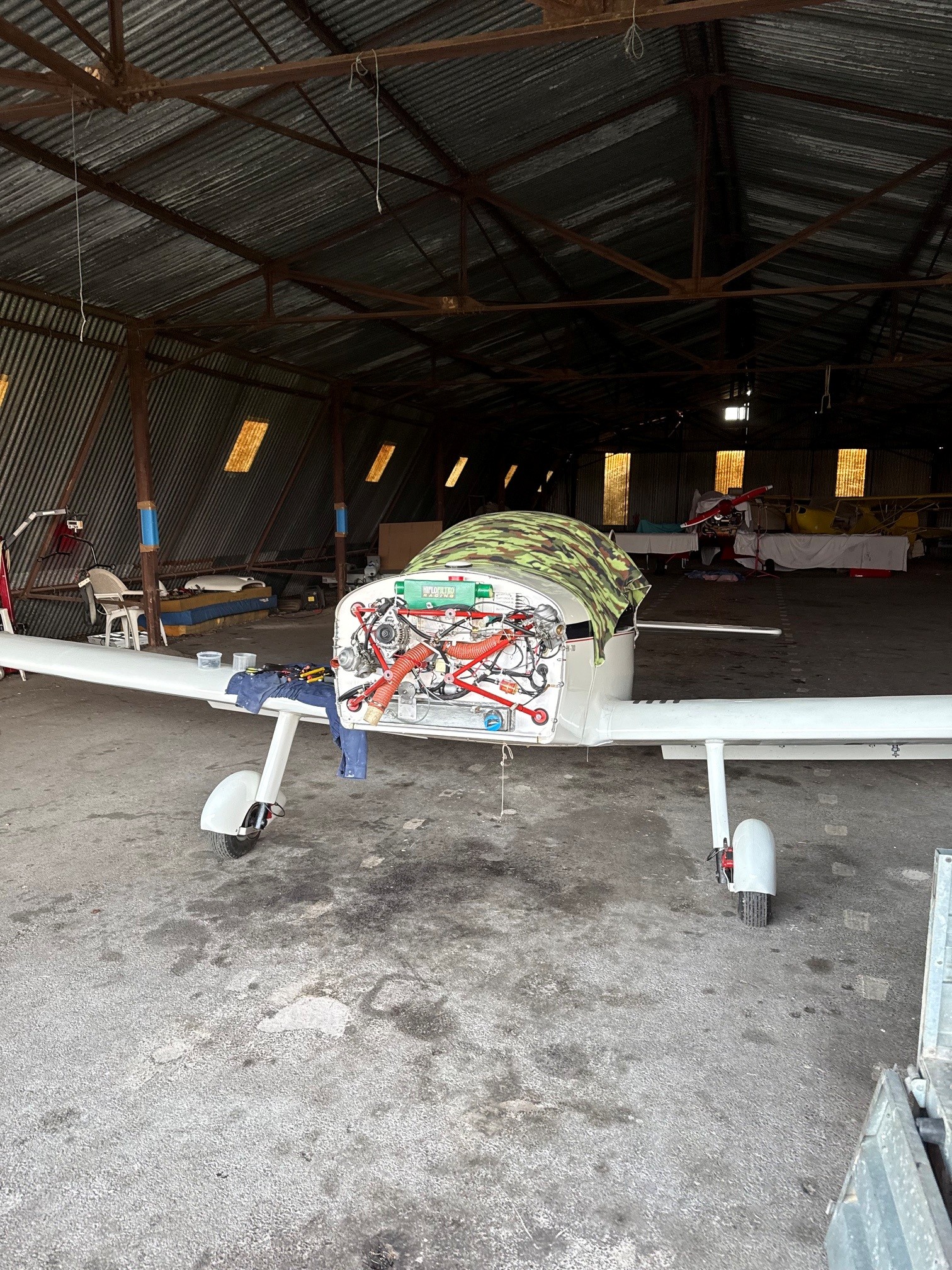
SOUS LE CAPOT, L’ILLUSION D’UNE REPARATION SIMPLE / The engine’s hidden truth
Après plusieurs mois d’attente, nous déposons enfin les caches-culbuteurs1. Chaque geste est calme, méthodique. On cherche un indice. Une trace. Une évidence.
Rien.
Pas d’huile anormale. Pas de casse visible. Aucun dégât apparent.
Puis Philippe remarque un jeu sur les tiges de soupapes du cylindre gauche, côté hélice. Armé de cales d’épaisseur, il reprend les réglages, ajuste les tiges, corrige ce qui peut l’être.
Ce genre de moment est trompeur. Une petite anomalie trouvée après des heures de doute suffit à rallumer l’espoir. Peut-être n’était-ce que cela. Peut-être la panne se résume-t-elle à un réglage déréglé, à une mécanique sortie de ses tolérances.
Je vérifie que la clé n’est pas sur le contact. Puis je brasse lentement l’hélice à la main.
Une compression. Puis deux. Puis trois. Puis quatre: quatre compressions nettes, franches, bien ressenties.
Le moteur semble vivant.
Et l’espoir revient avec force. Après ces mois d’attente… Il suffisait de juste 5min…
Read the English version below — click to expand
After months of waiting, we finally remove the valve covers. Every movement is calm, methodical. We search for a clue. A trace. A smoking gun.
Nothing.
No abnormal oil. No visible damage. No apparent issues.
Then, Philippe notices play in the valve stems of the left cylinder, near the propeller. Armed with feeler gauges, he rechecks the settings, adjusts the stems, and corrects what he can.
Moments like these are deceptive. After hours of doubt, finding even a minor anomaly is enough to rekindle hope. Maybe that’s all it was. Maybe the failure boils down to a misaligned setting, a mechanism pushed beyond its tolerances.
I double-check that the key isn’t in the ignition. Then, I slowly turn the propeller by hand.
One compression. Then two. Then three. Then four—four sharp, distinct compressions, each one clear and strong.
The engine seems alive.
And with that, hope surges back. After all those months of waiting… it only took five minutes.
LE MOTEUR RENAIT / The Engine Reborn
Je remets la batterie, retirée jusque-là pour éviter sa décharge. Nous sortons le FK9 ainsi que mon appareil. Le capot moteur reste déposé. Cette fois, rien n’est caché. Le moteur sera observé et écouté à nu, comme un patient sous surveillance.
Je m’installe aux commandes. Quelle sensation après presque 8 mois.
- Batterie : contact
- Magnéto 1 : ON
- Magnéto 2 : ON
- Pompe : ON
- Starter : tiré
- Gaz : réduit
- Démarreur : enclenché
Brouummm.
Le moteur part immédiatement et se cale dans un ralenti régulier. Ce son familier, rond, presque rassurant. Je repousse le starter et le laisse prendre sa température pendant que nous écoutons, attentifs au moindre changement.
Les constats tombent un à un :
- Les quatre compressions sont présentes
- La pression d’huile est normale
- Température moteur : rien d’inquiétant
- Température culasse : légère montée cohérente
Tout semble rentrer dans l’ordre.
Après la tension des derniers mois, ce simple ralenti a quelque chose de profondément apaisant. Une machine qui tourne donne toujours l’illusion de la santé.
Mais certaines blessures savent se faire discrètes.
Read the English version below — click to expand
I reinstall the battery, which had been removed up until now to prevent it from draining. We take out the FK9 and my device. The engine cowling remains off. This time, nothing is hidden. The engine will be watched and listened to bare, like a patient under observation.
I settle into the controls. What a feeling after nearly eight months.
- Battery: Contact
- Magneto 1: ON
- Magneto 2: ON
- Pump: ON
- Starter: Pulled
- Throttle: Reduced
- Ignition: Engaged
Vroom.
The engine starts immediately and settles into a steady idle. That familiar, smooth, almost reassuring sound. I push the starter back in and let it warm up while we listen, attentive to the slightest change.
One by one, the observations come in:
- All four cylinders have compression
- Oil pressure is normal
- Engine temperature: nothing alarming
- Cylinder head temperature: a slight, consistent rise
Everything seems to be falling back into place.
After the tension of the past months, this simple idle has something profoundly soothing about it. A running machine always gives the illusion of health.
But some wounds know how to stay quiet.
LE SON QUI NE DEVRAIT PAS EXISTER / A Sound that shouldn’t exist
Quelques minutes passent. J’augmente progressivement le régime: 1500 tours, 2000 tours.
Puis soudain :
CLAC. CLAC. CLAC.
Le son tranche l’air comme un marteau sur de l’acier. Sec. Métallique. Incontestable.
Je réduis immédiatement.
Le silence retombe, brutal. On se regarde. Personne n’a besoin de commenter ce que nous venons d’entendre.
Je recommence une dernière fois. Même montée en régime. Même attente suspendue.
Et de nouveau :
CLAC CLAC CLAC
Cette fois, le doute est mort.
Je réduis. Je coupe tout.
Le moteur s’arrête dans un dernier frémissement.
Philippe tranche le premier :
— Ce bruit n’est définitivement pas normal. Il y a du jeu dans l’hélice. Ce sont peut-être les paliers2. Dans tous les cas, je ne te laisse pas repartir comme ça.
Je réponds sans hésiter :
— Je ne comptais pas repartir avec ce bruit. Les paliers? On dirait plutôt quelque chose liée à la rotation. Deux pièces métalliques qui se touchent, mais pas de façon régulière.
Il acquiesce, déjà ailleurs, déjà dans la suite logique.
— Je vais déposer le moteur. Et tant qu’à faire, j’en profiterai pour remplacer les paliers... Il y a un jeu incontestable de l’axe de l’hélice.
La décision est prise.
Read the English version below — click to expand
A few minutes pass. I gradually increase the RPMs: 1,500, then 2,000.
Then, suddenly:
CLACK. CLACK. CLACK.
The sound cuts through the air like a hammer on steel. Sharp. Metallic. Undeniable.
I immediately throttle back.
Silence falls again, abrupt. We exchange a look. No one needs to say what we’ve just heard.
I try one last time. Same RPM climb. Same suspended anticipation.
And again:
CLACK CLACK CLACK
This time, there’s no doubt left.
I throttle down. I shut everything off.
The engine sputters to a stop.
Philippe is the first to speak:
— « That noise is definitely not normal. There’s play in the propeller. Could be the bearings. Either way, I’m not letting you fly like this. »
I reply without hesitation:
— « I wasn’t planning to fly with that noise. Bearings? Sounds more like something related to the rotation. Two metal parts touching, but not in a regular pattern. »
He nods, already mentally moving on to the next steps.
— « I’ll pull the engine. And while I’m at it, I’ll replace the bearings… There’s undeniable play in the propeller shaft. »
The decision is made.
LE MOTEUR SUR L’ETABLI, LA VERTITE EN ATTENTE / The engine on the bench, the Truth waiting
Les mois passent encore. Puis nous nous retrouvons devant l’avion, dans le hangar, pour déposer le moteur et l’emmener sur l’établi de Philippe.
Quelques semaines plus tard, le téléphone sonne.
— J’ai démonté le moteur… ton vilebrequin est en deux parties.
Le temps suspend sa course.
— En deux morceaux ? Photo ?
— Ce n’est pas une blague. La photo envoyé, c’est bien ton vilebrequin.
Le cliché arrive.
Read the English version below — click to expand
Months pass again. Then, we find ourselves back in the hangar, standing in front of the plane, ready to remove the engine and take it to Philippe’s workbench.
A few weeks later, the phone rings.
— « I’ve taken the engine apart… your crankshaft is in two pieces. »
Time stops.
— « In two pieces? Send me a photo. »
— « This isn’t a joke. I’ll send the photo—it’s definitely your crankshaft. »
En deux morceaux : la photo qui change tout / In two pieces: The Photo that changes everything
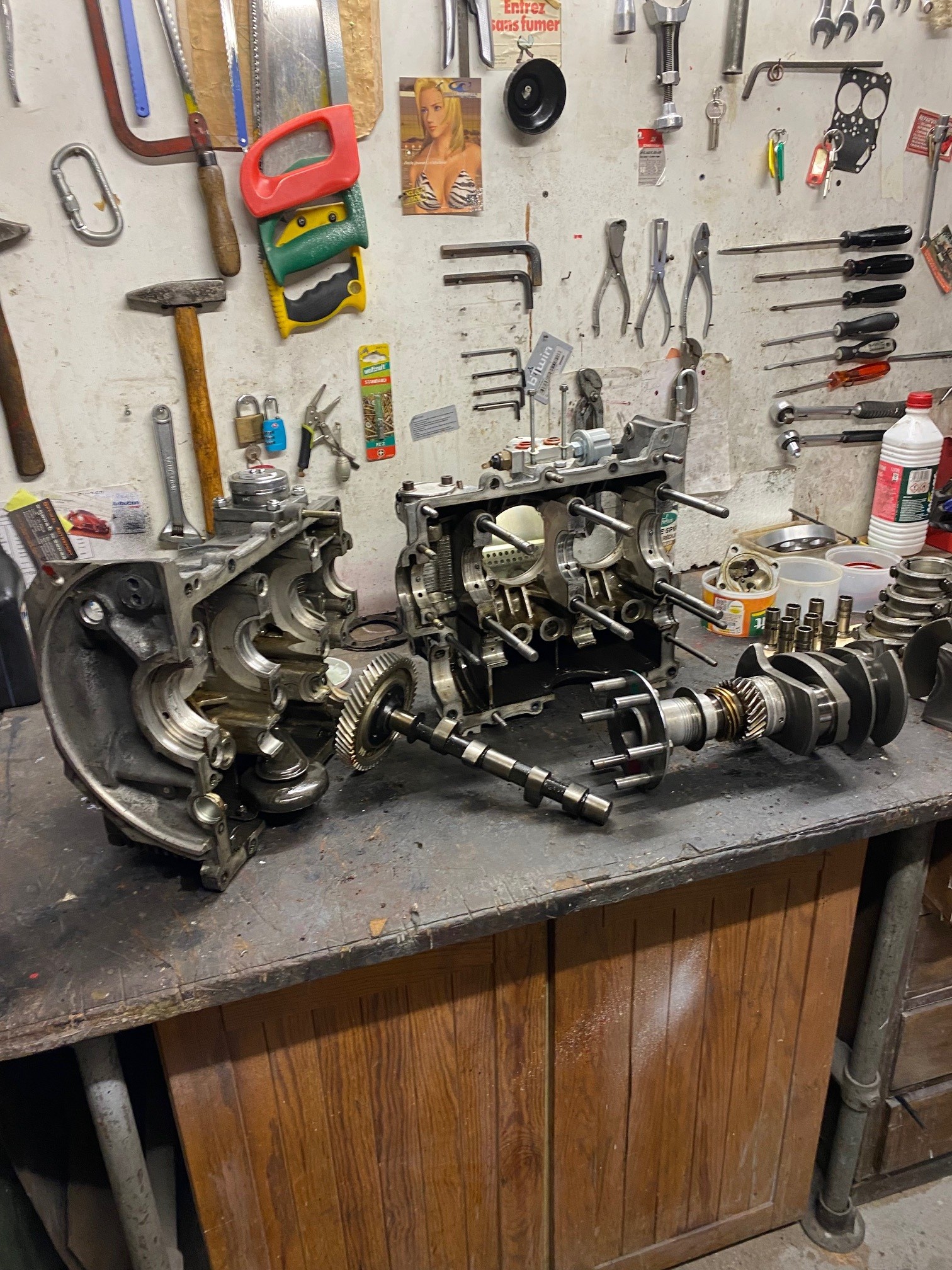
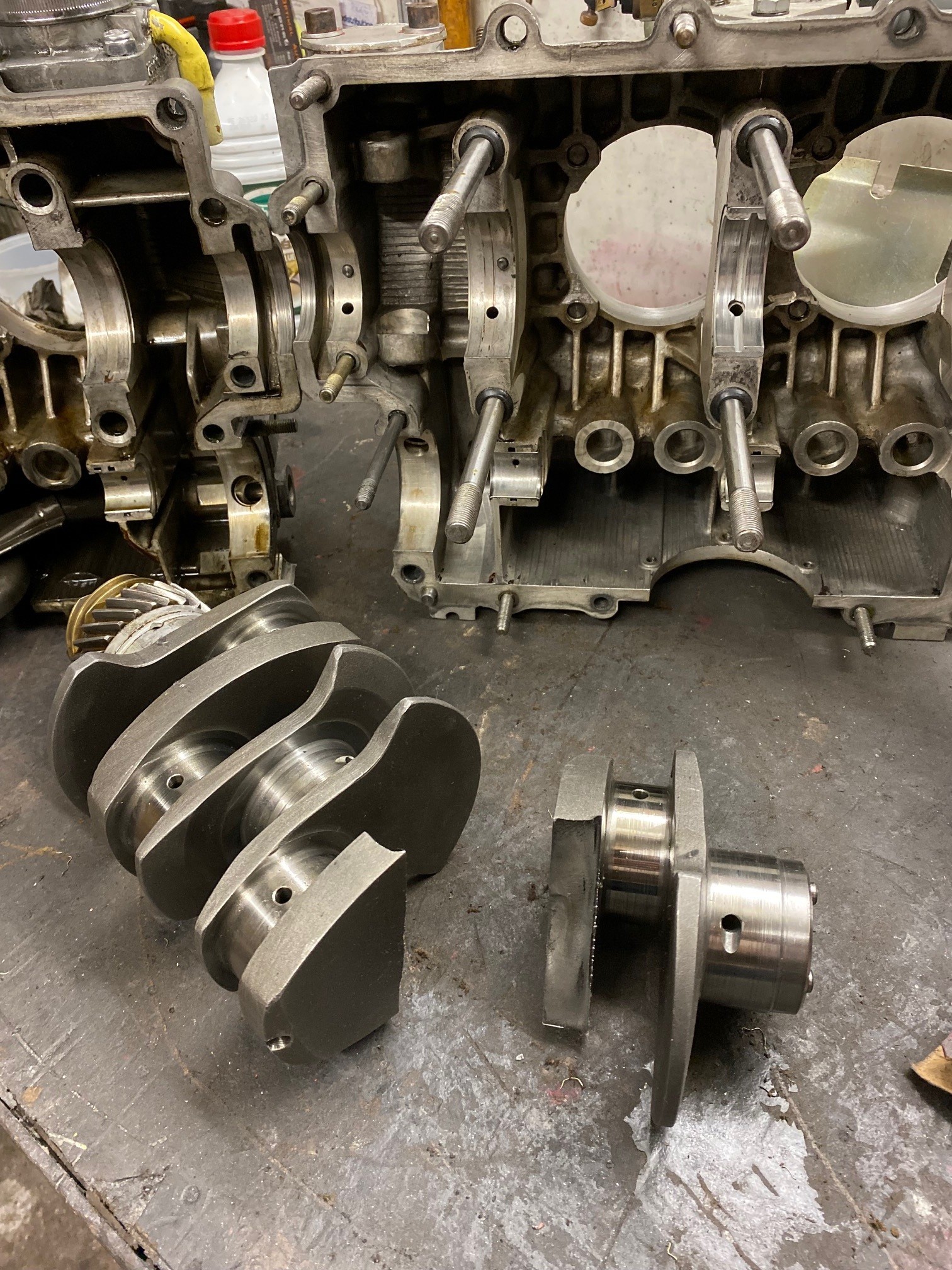
Le vilebrequin3, cœur battant du moteur, l’axe qui transforme le mouvement des pistons en rotation de l’hélice, avait rompu.
En plein vol.
La pièce était cassée, mais encore suffisamment solidaire pour continuer à transmettre une partie des efforts mécaniques. Voilà pourquoi le moteur n’avait pas explosé instantanément. Voilà pourquoi il avait encore tourné. Voilà pourquoi la conséquence immédiate fut surtout une perte de puissance, et non l’arrêt total. Et voilà aussi pourquoi, un jeu plus important sur l’axe de l’hélice était apparu et identifié par Philippe.
C’est aussi ce qui expliquait le bruit métallique entendu avec mon père : la rupture parlait déjà.
Avec le recul, la situation prend une autre dimension. Ce jour-là, je pilotais avec un vilebrequin cassé.
Read the English version below — click to expand
The crankshaft—the beating heart of the engine, the shaft that converts the pistons’ motion into the propeller’s rotation—had snapped.
In mid-flight.
The part was broken, yet still just solid enough to transmit some of the mechanical forces. That’s why the engine hadn’t exploded instantly. That’s why it kept running. That’s why the immediate consequence was mostly a loss of power, not a total shutdown. And that’s also why Philippe had detected the excessive play in the propeller shaft.
It also explained the metallic clacking my father and I had heard: the fracture was already speaking to us.
In hindsight, the situation takes on a whole new dimension. That day, I had been flying with a broken crankshaft.
POURQUOI LA PUISSANCE AVAIT CHUTE / Why the power had dropped
Un autre détail s’éclaire après démontage.
Pour comprendre ce qui s’est réellement passé, il faut “rejouer” le fonctionnement du moteur… morceau par morceau.
Pour une meilleure compréhension pour la suite, nous numéroterons les cylindres comme suit, en ce positionnant en face de l’hélice, regardant le moteur:
- De gauche à droite sur la première ligne (le plus proche du port hélice): cylindre 1 (à gauche), cylindre 2 (à droite).
- Deuxième ligne, proche du bâti moteur (ou du cockpit): cylindre 3 (à gauche), cylindre 4 (à droite).
Read the English version below — click to expand
Another detail becomes clear after disassembly.
To understand what really happened, we need to « replay » the engine’s operation—piece by piece.
For better clarity moving forward, let’s number the cylinders as follows, standing facing the propeller and looking at the engine:
- Front row (closest to the propeller hub):
- Cylinder 1 (left)
- Cylinder 2 (right)
- Back row (closer to the engine frame/cockpit):
- Cylinder 3 (left)
- Cylinder 4 (right)
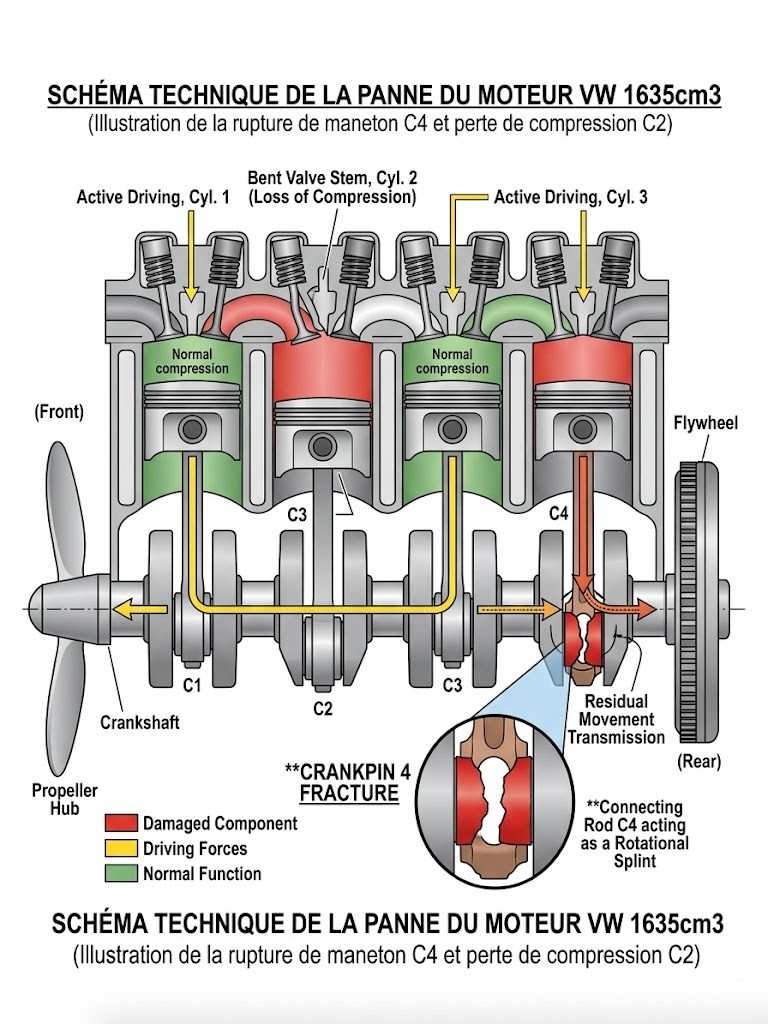
La partie avant du vilebrequin (côté hélice)
La perte de compression ne concernait pas le cylindre situé au niveau de la rupture, mais celui placé à l’opposé, côté hélice. Une tige de soupape y était légèrement voilée, perturbant la commande de la soupape. Rien de spectaculaire, mais suffisant pour dégrader son fonctionnement.
La soupape ne travaillait plus correctement. Le cylindre respirait moins bien. La compression chutait — et la puissance avec elle.
Autrement dit, la perte de performance ne provenait pas directement de la rupture du vilebrequin, mais de ses (probable/peut être) conséquences mécaniques sur la distribution.
Une défaillance localisée… dont les effets se manifestent ailleurs.
Read the English version below — click to expand
The front section of the crankshaft (propeller side)
The loss of compression didn’t affect the cylinder at the fracture point—instead, it impacted the opposite cylinder, on the propeller side. A valve stem there was slightly bent, disrupting the valve’s operation. Nothing dramatic, but enough to impair its function.
The valve no longer opened and closed properly. The cylinder couldn’t « breathe » efficiently. Compression dropped—and with it, power.
In other words, the performance loss wasn’t directly caused by the crankshaft fracture itself, but by its mechanical consequences on the valvetrain.
A localized failure… with effects that surfaced elsewhere.
LECTURE MECANIQUE DE LA PANNE / A mechanical analysis of the failure
Pour comprendre, il faut regarder précisément où et comment le vilebrequin a rompu.
Une rupture entre deux manetons
La cassure ne s’est pas produite sur un maneton, mais sur la portée située entre les manetons des cylindres 3 et 4.
C’est un point clé.
Le vilebrequin s’est donc séparé en deux parties :
- une partie avant, côté hélice, entraînant les cylindres 1, 2 et 3
- une partie arrière, côté volant moteur, liée au cylindre 4
Une séparation… restée partiellement solidaire
Dans un cas classique, une rupture à cet endroit entraînerait un désalignement immédiat et un arrêt moteur.
Ici, ce n’est pas ce qui s’est produit.
Les deux parties du vilebrequin sont restées en contact, probablement maintenues par :
- la géométrie des portées,
- les efforts mécaniques en rotation,
- et l’ensemble des pièces en contrainte autour.
Le moteur n’était plus monobloc. Mais il n’était pas totalement libre non plus.
Le rôle du cylindre 4 : maintenir la liaison
Le cylindre 4, situé côté volant moteur, continuait de fonctionner normalement.
Sa bielle, enserrant son maneton, jouait un rôle déterminant : elle contribuait à maintenir la cohérence de la partie arrière du vilebrequin, et à transmettre des efforts vers la zone de rupture.
À chaque cycle, les efforts de combustion appliquaient une contrainte sur la cassure, maintenant un contact entre les deux parties et permettant encore une certaine transmission du mouvement.
Read the English version below — click to expand
To understand what happened, we need to examine exactly where and how the crankshaft fractured.
A Fracture Between Two Crankpins
The break didn’t occur on a crankpin itself, but on the journal between the crankpins for cylinders 3 and 4.
This is a critical detail.
As a result, the crankshaft split into two sections:
- A front section (propeller side), driving cylinders 1, 2, and 3
- A rear section (flywheel side), connected to cylinder 4
A Separation… That Remained Partially Intact
In a typical scenario, a fracture at this point would cause immediate misalignment and engine shutdown.
But that’s not what happened here.
The two sections of the crankshaft remained in contact, likely held together by:
- The geometry of the journals
- The rotational mechanical forces
- The constraint of surrounding components
The engine was no longer a single, solid unit—but it wasn’t completely free to move, either.
The Role of Cylinder 4: Holding It Together
Cylinder 4, located on the flywheel side, continued to operate normally.
Its connecting rod, wrapped around its crankpin, played a decisive role: it helped maintain the integrity of the rear section of the crankshaft and transmit forces toward the fracture point.
With each combustion cycle, the forces exerted pressure on the break, keeping the two sections in contact and allowing some motion to still be transmitted.
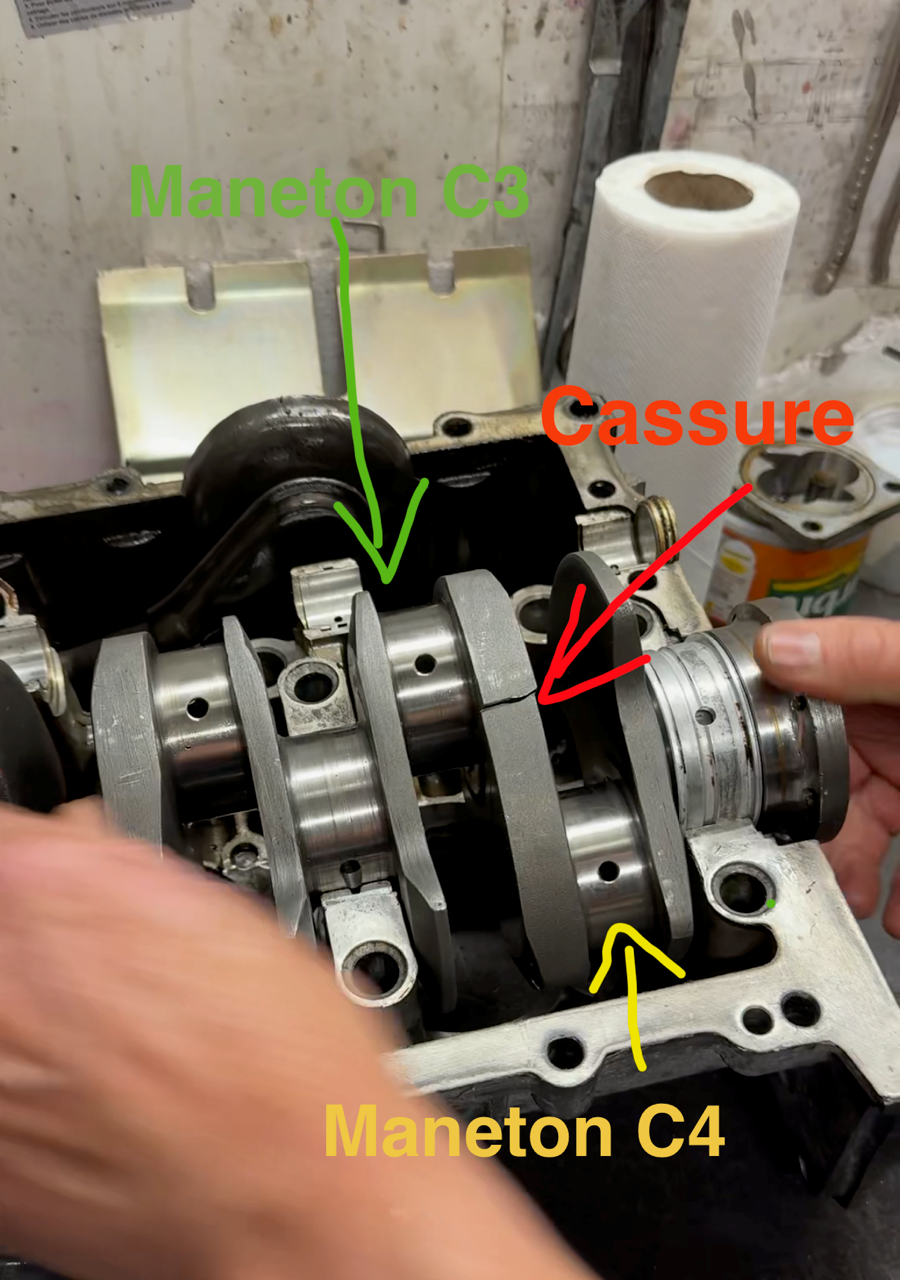
Elle sépare le vilebrequin en deux parties distinctes, tout en laissant un contact mécanique partiel.
À l’avant : un ensemble encore actif… mais perturbé
Côté hélice, les cylindres 1 et 3 continuaient de fournir l’essentiel de l’énergie.
Le cylindre 2, lui, avait perdu en efficacité à cause de sa soupape mal commandée. Il ne participait presque plus à la production de puissance, mais son piston suivait le mouvement imposé par les autres cylindres.
L’ensemble continuait donc à tourner — mais dans un équilibre dégradé, mécaniquement instable.
En résumé
Le moteur fonctionnait encore, mais sous une forme profondément altérée :
- Et la rupture, située entre C3 et C4, fragmentait l’ensemble sans le désolidariser totalement
- Les cylindres 1 et 3 entraînaient la rotation
- Le cylindre 2 suivait, avec une contribution réduite
- Le cylindre 4 maintenait une contrainte sur la zone rompue
- Et la rupture, située entre C3 et C4, fragmentait l’ensemble sans le désolidariser totalement
Read the English version below — click to expand
Up Front: An Assembly Still Running… but Disturbed
On the propeller side, cylinders 1 and 3 were still delivering most of the engine’s power.
Cylinder 2, however, had lost efficiency because of its improperly actuated valve. It was contributing very little to power production, while its piston simply followed the motion imposed by the other cylinders.
The engine assembly therefore continued to rotate — but in a degraded state, mechanically unstable and far from normal operating balance.
In Summary
The engine was still running, but in a profoundly altered condition:
- Cylinders 1 and 3 continued to drive the rotation
- Cylinder 2 followed along, with only a limited contribution
- Cylinder 4 maintained stress on the fractured area
- And the break, located between C3 and C4, fragmented the assembly without completely separating it
L’ENQUETE MECANIQUE : POURQUOI UN VILEBREQUIN CASSE-T-IL ? / Why Does a Crankshaft Break?
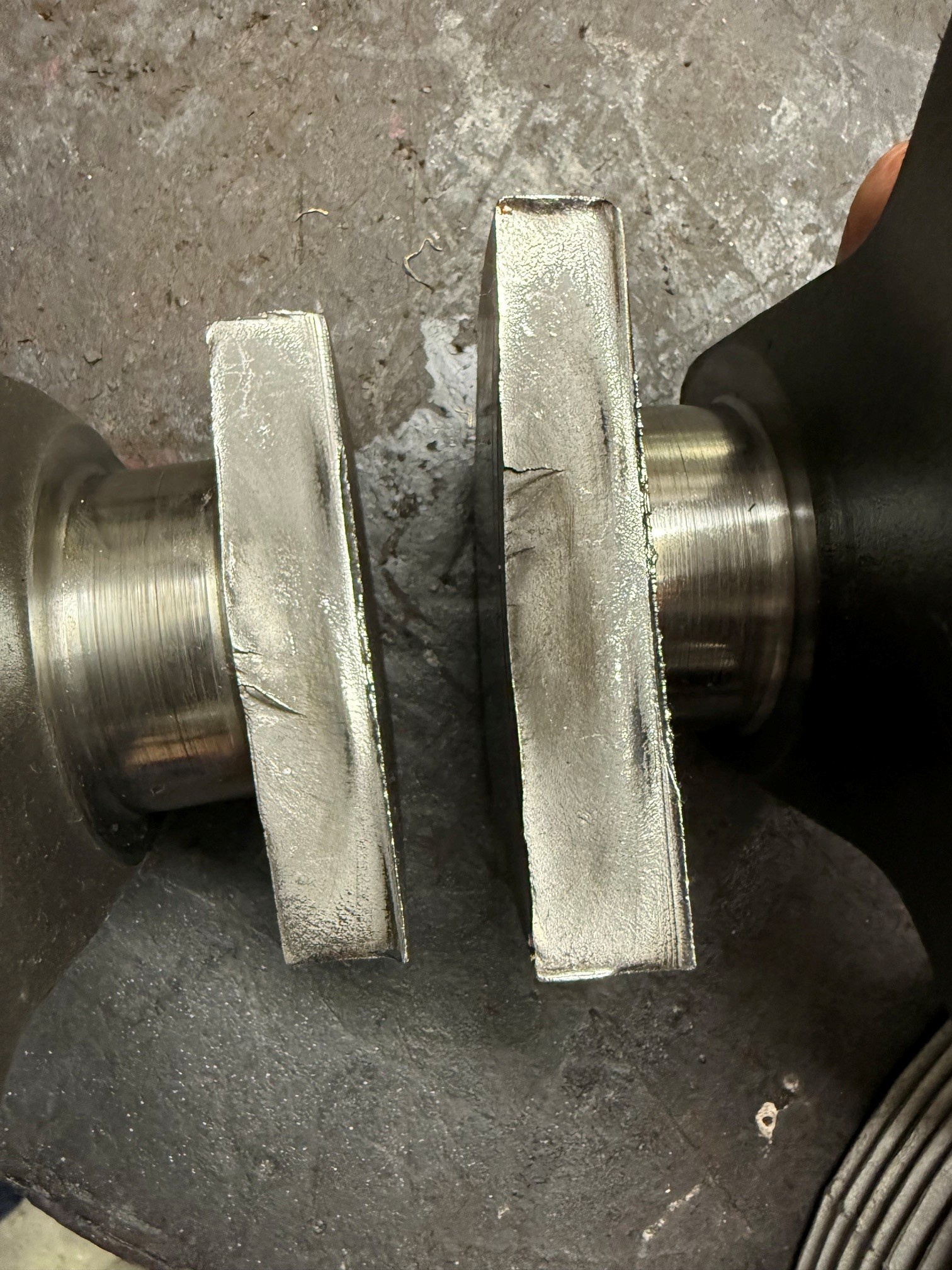
Sur la pièce rompue, un point de fatigue est visible. C’est souvent ainsi que les grandes ruptures commencent : non pas par un choc spectaculaire, mais par une microfissure discrète qui grandit à chaque cycle moteur.
Il faut rappeler un élément important : ce moteur avait vu ses cylindres réalésés, passant de 1600 cm³ à 1835 cm³. Le vilebrequin, lui, n’avait pas été remplacé.
Plusieurs hypothèses sont donc plausibles.
1. Fragilité présente dès l’origine
Défaut métallurgique, traitement thermique imparfait, inclusion dans l’acier, lot de fabrication médiocre… certaines pièces portent une faiblesse invisible dès leur naissance. Elles fonctionnent parfois longtemps avant de céder brutalement.
2. Choc ancien sur l’hélice ou la ligne d’arbre
Un contact hélice/sol, même modéré, peut transmettre des efforts violents jusqu’au vilebrequin. Une pièce peut survivre au choc… puis rompre bien plus tard par fatigue progressive.
3. Dimensionnement devenu limite après passage en 1835 cm³
L’augmentation de cylindrée peut accroître les efforts de combustion et les contraintes torsionnelles. Si le vilebrequin d’origine travaille déjà près de sa limite, les heures à haut régime peuvent accélérer l’apparition d’une fissure.
4. Déséquilibre ou vibrations harmoniques
Une hélice mal équilibrée, un montage imparfait, ou certaines plages de régime peuvent générer des vibrations répétées particulièrement destructrices pour un vilebrequin.
5. Lubrification insuffisante ou pollution de l’huile
Même sans alarme franche de pression d’huile, une lubrification imparfaite peut accélérer l’usure des portées et créer des contraintes anormales à long terme.
6. Historique inconnu de la pièce
Sur des mécaniques anciennes ou reconditionnées, il arrive qu’une pièce ait déjà vécu plus qu’on ne le croit : surchauffe passée, rectification antérieure, fatigue cumulée, réparations anciennes.
En matière de rupture mécanique, la vraie cause est souvent multiple : une faiblesse initiale aggravée par l’usage, les vibrations, les charges et le temps.
Read the English version below — click to expand
On the fractured part, a clear fatigue point can be seen. This is often how major mechanical failures begin: not with a spectacular impact, but with a tiny crack that slowly grows with every engine cycle.
One important detail must be kept in mind: this engine had previously been bored out from 1600 cc to 1835 cc. The crankshaft itself, however, had not been replaced.
Several explanations therefore remain plausible.
1. An Original Weakness in the Part
A metallurgical defect, imperfect heat treatment, an inclusion in the steel, or simply a poor manufacturing batch — some components carry an invisible weakness from the very beginning. They may operate for years before suddenly failing.
2. A Previous Propeller or Drivetrain Shock
Even a relatively minor propeller strike can transmit severe loads through the crankshaft. A component may survive the initial shock… only to fail much later through progressive fatigue.
3. The Original Design Reaching Its Limits After the 1835 cc Conversion
The increase in displacement may have raised combustion forces and torsional stresses. If the original crankshaft was already operating close to its limits, long periods at high RPM could have accelerated crack formation.
4. Imbalance or Harmonic Vibrations
An improperly balanced propeller, imperfect assembly, or certain RPM ranges can generate repeated harmonic vibrations that are especially destructive for a crankshaft.
5. Insufficient Lubrication or Oil Contamination
Even without a clear oil-pressure warning, imperfect lubrication can accelerate wear on bearing surfaces and create abnormal long-term stresses.
6. An Unknown Service History
With older or rebuilt engines, some components may already have endured more than expected: previous overheating, earlier machining work, accumulated fatigue, or undocumented repairs.
In mechanical failures, the true cause is often not a single event, but a combination of factors: an initial weakness aggravated over time by use, vibration, load, and fatigue.
CE QUE RAPPEL CETTE HISTOIRE
Les machines préviennent parfois. Mais dans une langue discrète : une vibration, une perte de puissance, un bruit à peine perceptible, une anomalie passagère.
Encore faut-il savoir les écouter.
Ce jour-là, l’avion s’est posé. Le moteur a continué à tourner. Le diagnostic n’a pas été immédiat. Pourtant, au centre de tout, une pièce essentielle était déjà brisée.
Il suffit parfois de quelques millimètres de métal fissuré pour faire basculer un vol.
Et inversement, de quelques décisions prudentes pour rentrer entier.
La suite ? Reconstruire. Comprendre. Fiabiliser.
Puis revoler…
Read the English version below — click to expand
What This Story Reminds Us
Machines sometimes give warnings. But they speak quietly: a vibration, a slight loss of power, a barely perceptible noise, a momentary anomaly.
The challenge is knowing how to listen.
That day, the aircraft landed safely. The engine was still running. The diagnosis did not come immediately. And yet, at the center of it all, a critical component was already broken.
Sometimes, only a few millimeters of cracked metal are enough to change the outcome of a flight.
And conversely, only a few careful decisions are needed to make it home safely.
What comes next?
Rebuild. Understand. Improve reliability.
Then fly again…
- Cache culbuteur: couvercles de protection montés sur les culbuteurs et la distribution, conçus pour retenir l’huile à l’intérieur de la culasse tout en protégeant le mécanisme des contaminations extérieures. ↩︎
- Paliers : surfaces/supports sur lesquels tourne un arbre mécanique. ↩︎
- Vilebrequin : pièce maîtresse transformant les mouvements des pistons en rotation. ↩︎

